
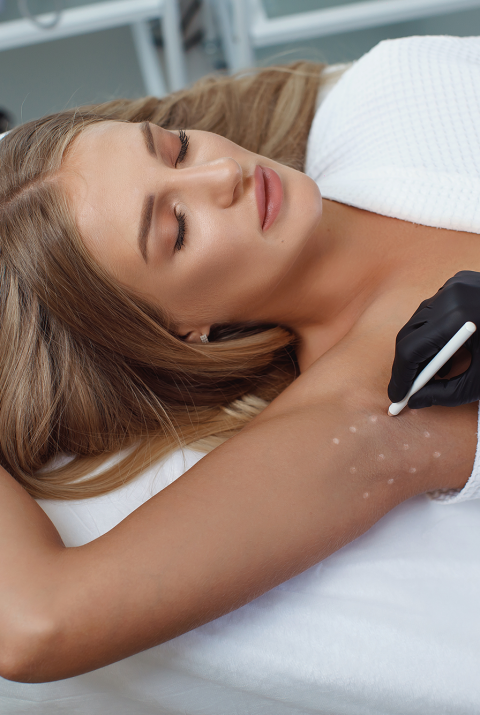
Hyperhidrosis, the medical term for excessive sweating is an issue that millions of individuals deal with throughout the world. While sweating is a normal response to heat and stress, individuals with hyperhidrosis sweat in amounts greater than that which is required for proper thermoregulation. It can be completely embarrassing, unpleasant, and interfere of life. Fortunately, modern dermatology has a number of non-invasive, non-surgical treatments that can provide effective management of perspiration production.
In case you’re searching for some alternatives that don’t involve surgery or extended downtime, here’s a guide to the least invasive hyperhidrosis treatments — and how they work.
Understanding Hyperhidrosis
You may have hyperhidrosis in several areas of your body, or it might occur only in one area. These include your:
- Underarms
- Palms
- Soles of your feet
- Face
- Scalp
It can be primary, with no underlying health problem that is the cause, or it can be secondary to medical issues or certain medications. Although it’s not risky, the condition can be particularly devastating in terms of confidence and 24 hour comfort – so much so that treatment is a must for many.
Topical Clinical-Strength Antiperspirants
Prescription or clinical-strength antiperspirants are one of the first line of treatments to moderate hyperhidrosis. These usually include aluminum chloride, which blocks sweat glands temporarily.
Why it’s considered least invasive
- No needles, downtime or procedures
- Easily applied at home
- Effective for many with mild symptoms
These can be used at night, when the sweat glands are most dormant and so the formula can penetrate more efficiently. While it is possible some people may experience mild irritation, this can be mitigated by using moisturisers or lower-concentration formulations.
Prescription Wipes and Creams
Dermatologists can also provide topical anticholinergic agents, in the form of wipes or creams. These curb sweating by interrupting signals between nerves and the sweat glands.
Benefits
- Completely non-invasive
- For underarms, hands & feet
- Useful in some who are intolerant of aluminum chloride
This can be a nice middle of the road option for patients who require more than over-the-counter antiperspirants, but are not interested in receiving injections or using a device to treat their condition.
Iontophoresis for Hands and Feet
Iontophoresis is one of the most proven options for sweaty palms and soles without going under the knife. This treatment utilizes a low-voltage electrical current passed through water-filled containers to diminish perspiration.
Benefits
- No pain and no surgery
- Possible home usage with a private iontophoresis device
- The most effective solution for palmar or plantar hyperhidrosis
The outcome improves after several sessions, and some maintenance suggests applying the methodology to complete the effect. Most individuals are scared of electricity; however, they feel a light tingling.
Oral Medicines
When sweating occurs all over the body, a physician may recommend oral anticholinergic drugs. They minimize sweat gland activity.
Advantages
- A perfect choice for generalized hyperhidrosis
- Easy-to-use
- Good for people who cannot get other procedures
Side effects include dry mouth or blurring of vision, so these medications are usually used only when standard options are inefficient.
Botox® Injections
Although it sounds painful, Botox for hyperhidrosis is considered minimally painful with a long-lasting effect. The therapy temporarily blocks nerve signals to sweat glands.
Benefits
- Excellent solution with strong sweat reduction
- Results last 6–9 months
- Fast procedure
- Most commonly used on underarms, but also hands and feet
Slight discomfort is common, but the improvement can be life-changing.
Microwave Therapy: Non-Surgical Energy-Based Option
Microwave therapies such as miraDry® provide long-lasting reduction of underarm sweat. The device uses controlled heat to destroy sweat glands.
What makes it minimally invasive
- No incisions
- Local anaesthesia for comfort
- Results may be long-lasting or permanent
There may be minor swelling or tenderness afterward, but most people return to normal activities quickly. Sweat glands do not regenerate, making this a powerful option.
Choosing the Right Non-Invasive Treatment
The most appropriate treatment varies, depending on severity, location affected, and comfort level with the options. Topical treatments are usually the starting point, but many patients seek longer-lasting results through device-based therapies.
A dermatologist can help narrow down the best, least invasive choice for your needs.
Final Thoughts
Hyperhidrosis can be exhausting however, with current dermatological options for controlling it being safe, non-surgical and very effective. Whether you favor basic, at-home treatments such as antiperspirants and iontophoresis or more elaborate interventions including Botox and microwave therapy, you can find relief without having to resort to surgery.
If you are bothered by sweat, and want to reduce excessive underarm sweat or eliminate the effects of hyperhidrosis, then these treatment options may be right for you.